Thursday, 23 March 2017

New 13 Tee Complex


By now I am sure everyone is aware that we have been working on upgrading our 13th Hole Tee Complex. First and foremost, Brett, myself, Sydney and the grounds crew, would like to thank you all for your patience during the upgrades and we are as aware as you are that the time frame for this has dragged on somewhat.

 The upgrades have taken shape with two results in mind. Firstly: level and expand the playing surface as well as improve irrigation coverage of the main tee deck. To give us and you more options for tee marker placement and a high quality playing surface. Secondly: design and install a completely new forward tee deck to allow for a more realistic and enjoyable challenge for players of the forward markers.

Frozen Ground
Mini-Ex couldn't break it
When ground was broken in January, the original plan was to have the tees ready for seeding the earliest the weather would allow (in time for March). The weather however had other ideas. As we all know, this winter has been a little nasty. The impact it had on this project cannot be understated. The  ground froze so hard that the Excavator couldn't break through.
The resulting chunks of frozen sand made it very hard to work with and almost impossible to level out. The freezing temperatures also had a huge effect on our equipment. Batteries running flat and hydraulics ceasing were common place for days on end.

After the initial frozen blast came, the seemingly endless snow dumps made work almost impossible. We managed to continue and get the irrigation trenches dug and then of course came the rain, making gluing of pipe and fittings for the install extremely difficult.

We understand that during all of this our members and guests have been faced with an eyesore when you approached the area and have been asked to play off an inadequate smaller tee or a temporary mat which dramatically shortened the hole, both of which has had an impact on the enjoyability of your round. It is because of this we have decided to sod the main teeing areas and leave the seeding to the banks, This course of action will allow opening of the tees in a much earlier time frame. I can now happily say that there is now light at the end of the tunnel.

Laser leveling of the back tee
Final Grading before laser levelling

Most of you have no doubt noticed that the project has come on in leaps and bounds recently. We have firstly completed our main objectives for both tees. The back tee area has been increased from 1300sqft to 2800sqft with hugely improved irrigation coverage of not only the teeing space but the entire carry from tee to fairway. The forward tee has turned a daunting 487 yard hole from the Yellows to a manageable but still challenging 413 yard hole.

Building up new soil on forward tee wall


Necessary protection during heavy rain fall


Now the sodding on the white tee deck is complete, we hope to have the forward tee deck completed by weeks end. On the white deck, the banking and walk on/offs will be seeded with areas around the back and the left hand side of the tee being left to naturalize. If the weather stays warm with the sunshine and showers we are currently experiencing, we hope to see germination begin in a couple more weeks.

Back tee deck ready flat raking and sod

Forward tee deck ready for sod

We hope to have you all teeing from the new decks as soon as possible. We will be putting up traffic control to help direct you around the seeded and recovering areas. Please try to follow our guidance in this matter by taking the time to follow fences and signage. With your help and consideration, the grow in, recovery and final completion of the project WILL be expedited and we can all once again enjoy the Tranquility and Nature of one of Victoria's best Par 5s.


Monday, 13 February 2017

The End is in Sight.

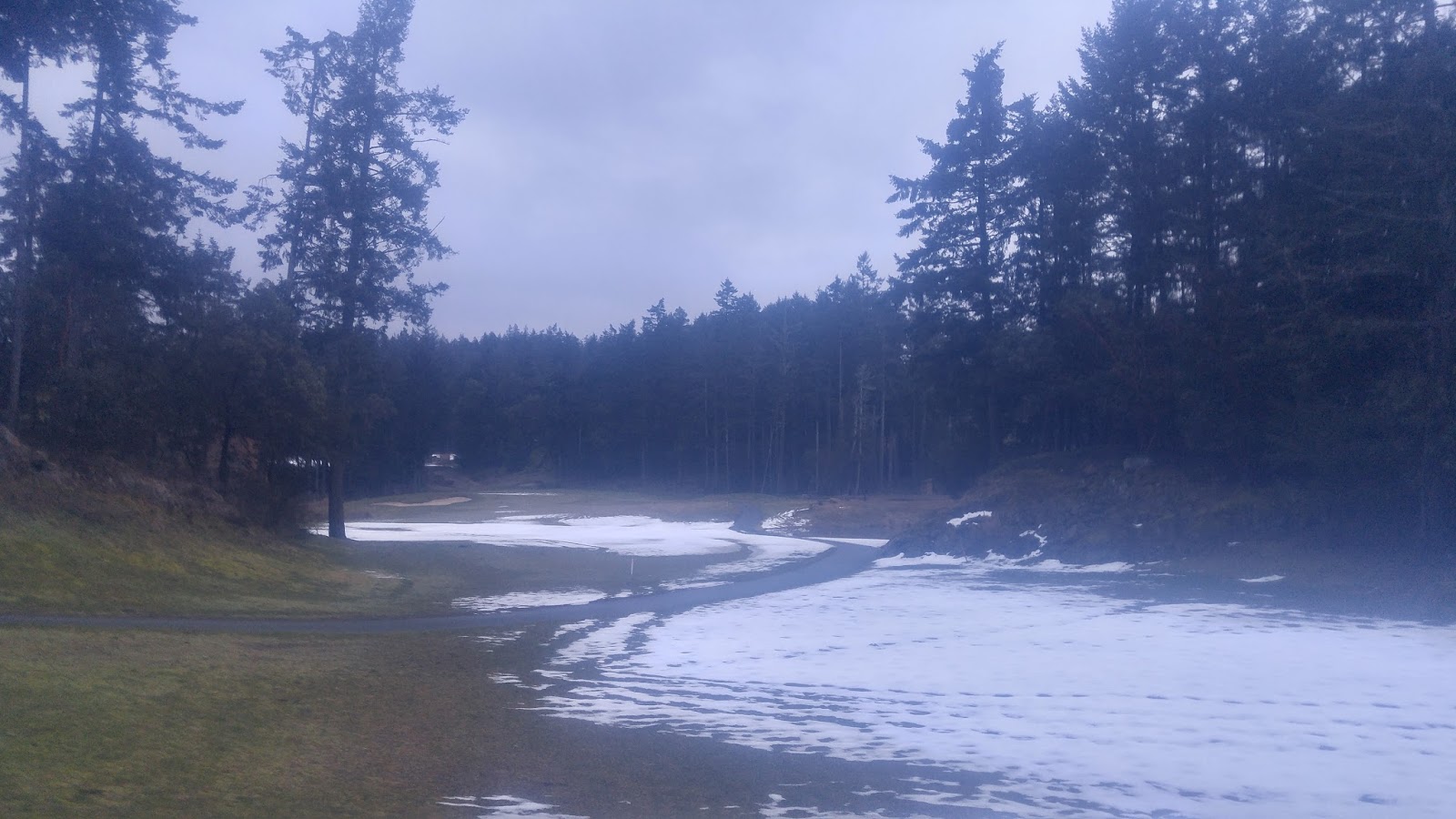
This Winter has been long and cold and now with the end in sight it still seems to be lingering. It is easy to think when you drive around town that especially on days like today the cold, snow,and ice is behind us. Unfortunately on course is a different matter. Below are some photos taken on Sunday the 12th of February. 

 
View from 1 across 9 to 10.

 
4 green still covered

 
8 green still covered

 
11 and much of the back 9 still almost entirely covered.


                                                         9 from tee to green is covered.

The temperatures are on our side and we are seeing improvements everyday. The front 9 will be first to open with Wednesday looking possible but we can still expect a few more days of closure on the back 9 due to the thick blanket of snow and minimal melting.

Keep and eye on the website http://www.golfbc.com/courses/olympic_view/about/conditions and we'll see you all soon.

p.s Sydney is still out there everyday chasing those geese away who by now think they own the place.


Monday, 9 January 2017

This Winter


So far this Winter from mid December in to the new year we have seen some extremely cold weather. It started with snow around the 6th of December, where at Olympic View we saw about 3 to 4 inches on course.


Then a week later we saw more snow on the 12th. During this period we did not see temps rise above 2.5C.

Almost exactly a week after on the 18th we saw yet more snow, admittedly not at much as previous  snow falls. During this period we didn't see temperatures rise above 1.0C.

 However, on Dec 21st after a brief frost delay we managed to open. This was after two consecutive days of temperatures rising above 5.0C. These higher temps allowed for our greens to thaw completely which meant that a pre-Christmas round of golf was possible. Unfortunately this wasn't to last and on the Christmas Eve the temperatures plummeted again to 0.9C that day and the following three days also didn't see a huge rise. On the 27th we once again opened after a frost delay and it seemed that from then until the next closure on the 30th and 31st we got rain as temperatures settled around the 4.0C mark.


HAPPY NEW YEAR!! More Snow arrived
on the 1st of January 2017.


What followed was referred to as an Artic Blast by meteorologists. Temperatures plummeted to -3.0 and biting wind gusts reached 70kph only adding to the coldness on course. This lasted for 5 days with temperatures only making it up to -1.4.


Course conditions were impossible with ice building up on cart paths, fairways as well as the fountain from water run off.


These remaining photos were taken on Monday the 9th of Jan. 7 Cart Path and carry along with considerable ice build up on 3 and 17 ranging from 2 to 3 inches deep.


It is worth noting that during December we had a total of 20 days of rainfall resulting in around 152mm of precipitation. The following rain - freeze - rain - freeze cycle has meant that we have developed a thick frozen layer under ground.


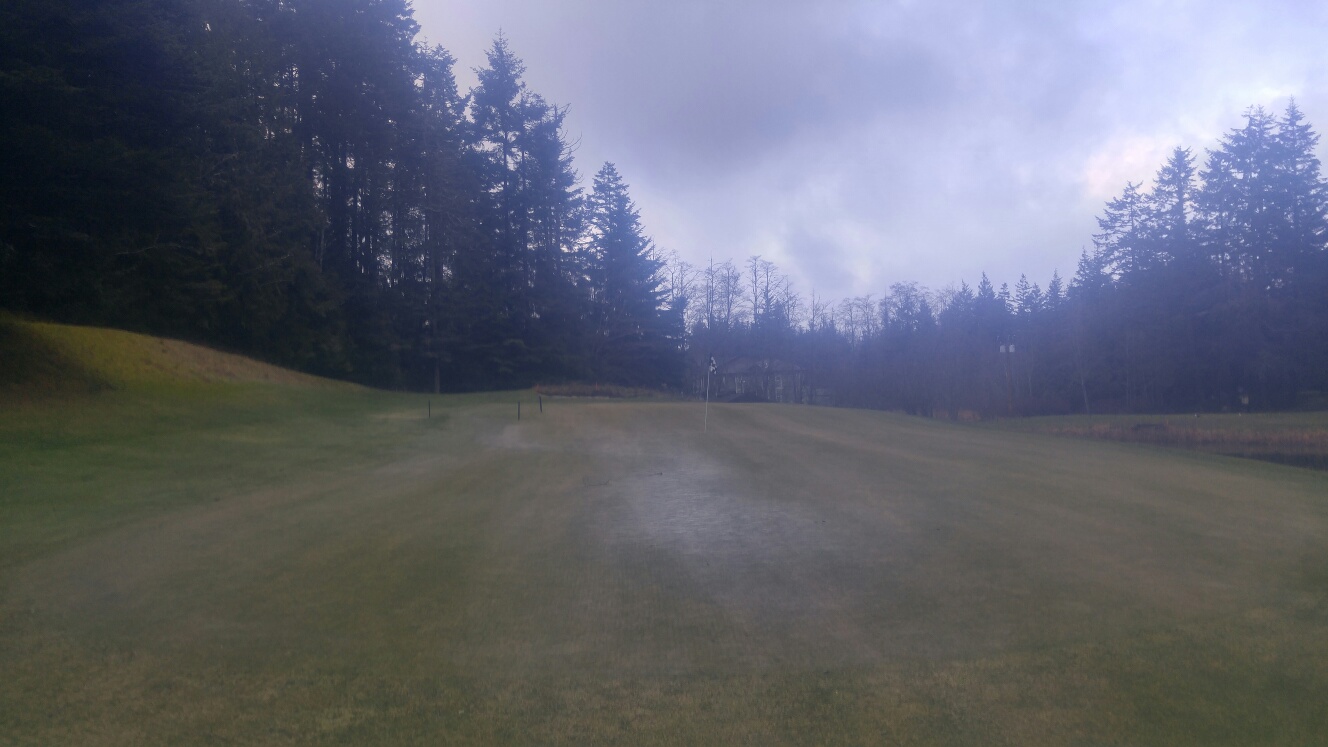
A heavy downpour at about 4 am on the morning of the 9th help to show the extent of the frozen ground conditions on the greens. The below photos were taken in the afternoon of the 9th and they show the water from the 4 am rain still sitting on top of the green.


                                                              10 Green
 8 Green

                                                               13 Green
 14 Green

Measurements taken with a probe show that the frozen layer extends 3 to 4 inches in to the ground, (a hammer was needed to be used to penetrate this layer). This long cold period has taken it's toll on some of our greens with our grass going dormant with the ground temperature being far lower than the current air temperature. To allow play on the course before a complete thaw of this frozen layer would result in a huge amount of irreversible damage to the plant and weaker greens moving into Spring.

The forecast for this week once again looks cold with temperatures not looking to rise above 2-3 C with nights getting in to the minus figures again. The grounds staff are out on the course everyday checking for the frost depths and thawing of the ice and we will open as soon as possible. We thank you all for your patience and understanding. 

Wednesday, 27 July 2016

A Message from Sydney the Goose Dog.


I have been waiting patently in the bushes for these annoying Goslings to grow up a bit so that I can get them to fly away. I have tried herding them on land and in water but until they are strong enough to fly away the best I can hope for is to keep them in their ponds.
As soon as my back is turned they climb out again. I want to personally thank every one for your patience and I hope my efforts have kept the greens and fairways cleaner for your golfing balls this year.
One more thing, you may have heard me barking when I am running around next to Sean's cart. I hope I haven't disturbed your game too much I am very excitable and I also don't want him to drive away without me. I am getting better and will try to keep my bark for the geese.

Wednesday, 11 May 2016

A message from Sydney the goose dog.


Some of you may have noticed that despite my efforts, a couple of geese have been successful in rearing some goslings around Hole 8 and Hole 12 area. If you hit your ball near them, please approach with care as the parents can be quite aggressive. I am a trained professional and I know how to handle them, so if you see me chasing them down please don't try to copy me as it's dangerous and you can't run as fast as I can.

On another note, you
may have guessed that Olympic Views irrigation system has been pressured up and I would like to ask you keep an eye out for any unusually wet areas and let a member of our team know if you see one. As you can see in the video below geese aren't the only thing I like to chase and I will be along as soon as possible to show that leak who's boss.


Thursday, 14 April 2016

Aeration

It is April and spring is finally here. The flowers are beginning to bloom, temperatures are rising and the course is getting back into peak form. Now why on earth would the Grounds Team decide to go and destroy the course for us? Again! Yes, every golfer out there would know that I am referring to Spring Aeration. That time of year, when the course is just beginning to dry out and firm up. Then, the Grounds Team decides to poke holes and cover the greens with sand.

There are many reasons why the Grounds Team pushes to have the course aerated at least twice a year, to go along with additional cultivating practices throughout the season. Almost all of these reasons have to do with the perception of how golf courses should play; with most of the focus being on the high demand and playability of greens each and every day. The performance of greens is often judged by how they perform on the surface and so they should be. All golfers want greens that are smooth, fast paced, receptive and most importantly - consistent from hole #1 through #18. It is often the performance underneath the surface that allows us to push the li
mits for golfers. The 3 main reasons why we aerate multiple times throughout the year are to relieve compaction, increase rooting structure and remove thatch from the upper soil profile.

As the days and weeks go by, compaction is an inevitable occurrence on greens. It is caused by our daily maintenance practices which includes mowing and rolling along with additional equipment that travel over greens each day. However, the major cause of compaction is from the traffic accumulated by the sheer number of golfers walking on the greens. The typical foursome takes over 300 footsteps per green, with an average of 50 foursomes per day, this equates to 15,000 steps each day! When we aerate greens, we relieve compaction by increasing soil porosity; which is the flow of air throughout the soil. From a turf management stand point, increasing airflow increases void space between soil particles which in turn increases the rate of infiltration or drainage. Increasing air flow also creates an overall better growing environment for turf which reduces the need for fungicide applications as disease pressure is reduced.

So what does adding additional air flow to the greens mean for golfers? Relieving compaction might not seem necessary at this time of year, but lets take a moment and think of this scenario. It is the middle of July and you are 100 yards from the green on the very first hole. The pin is at the front and you land your wedge on the green and in front of the pin. Your excitement has quickly turned to frustration as you watch your ball take one massive hop followed by a few more and your ball rests at the back of the green. What once looked like a birdie putt from within 15 ft has turned in to a 90 ft cross country putt down hill. Good luck making birdie let along trying to avoid a 3-putt on the very first hole.

A healthy root structure is arguable the most important factor to allow the Grounds Team to push the limits every day. Without a well structured root system, we are unable to push the playability of our greens by double cutting from time to time or rolling 5-7 days per week. These maintenance practices cause additional stress to the turf and without healthy roots we are increasing the chance of disease and even loss of turf altogether. When we aerate turf the additional air flow in the soil allows the roots to easily grow into the air spaces provided. Lastly, when we aerate turf, we will sever the roots directly underneath. If this is done during the growing season then this will actually increase overall root mass by stimulating root growth all around. The more root mass/depth that we have; the more we can push the limits on our golf course each and every day.

Earlier I talked about the removal of thatch being one of the key reasons why Grounds Teams aerate golf courses. So what is thatch? Thatch is the accumulation of an organic layer consisting of dead/decomposing leaves, stems and roots. It will act like a sponge and can hold multiple amounts of its own weight in water at the surface. When thatch is in excess and wet conditions are at hand, it can contribute to mechanical damage such as scalping. This is caused by the front and rear rollers settling in this sponge like material which can cause the mower blades to cut turf at much lower height. By removing thatch through aeration and filling the holes with sand, we create an avenue for air and water to penetrate into the soil which creates better turf all around.

Now that I have told you some of the benefits of aeration and how it affects you as a golfer, I am going to talk about what we have done this spring. There are always obstacles every time aeration is being planned. Weather, labour resources, equipment and the demand for the golf course staying opened are the main obstacles that come to mind. What the weather is going to do is often an obstacle that you have a game plan and a back up plan if the weather decides to take a turn for the worst.

In the early spring, we had a lot of wet weather resulting in very soft conditions. With just a few days to go until the big day and little sun to dry up the course, we decided to go with our backup plan. Tees, fairways, approaches and collars remained the same. We used 1/2" hollow tines with a fairly tight spacing to remove as much thatch as possible. Additionally, we're planning on double aerating #5 & 10 fairways three times this year in an effort to make a more dramatic impact on the thatch. For greens, our game plan went from removing cores using 5/8" hollow tines to going over greens twice with a combination of solid and hollow tines. First, we had an aerator set up with alternating 3/8" solid tines and 1/4" hollow tines. We then followed in behind with an aerator set up with all bayonet tines. This was combined with a heavy topdress and brushing to fill in the holes which create channels for air and water to flow through the soil profile.

The result of this plan was a lot of disturbance to the soil with little disruption to golfers. Our healing time on greens was expected to be 10-14 days. I would encourage all Members and Guests to come to the golf course this week and check out the condition and playability of the greens. We are currently in the process of finishing up fairways and approaches and will be starting tees next week as our labour restricts us from completing all areas at once.

I have provided a few websites below for additional information if you wish to read more on the topic:

Tuesday, 15 March 2016


The Problem with Bunkers

The Rules of golf define a bunker as:


A hazard consisting of a prepared area of ground, often a hollow, from which turf or soil has been removed and replaced with sand or the like. Grass-covered ground bordering or within a bunker is not part of the bunker. A wall or lip of the bunker not covered with grass is part of the bunker.

Source: http://rulesacademy.randa.org/definitions/


Bunkers can be a pain in the behind from both a maintenance and a golfing stand point. Golfers hate them and despise the thought of going into them. Fearless is a Superintendent that wants to add bunkers or make them bigger or even deeper. Even normal upkeep and renovations can come under the scrutiny of passing golfers.

So why do we have them? Why does a Superintendent spend so much time and money raking, weeding, removing rocks and debris, moving and adding sand, trimming edges, mowing banks, refreshing drainage, fixing wash-outs caused by rain and irrigation, repairing worn entrance and exit points, redesigning, bowling out and installing liners. It’s funny how in depth the list of constant daily maintenance goes into a course feature that is so unpopular.
Line trimming bunker edges.
Over time, the sand from thousands of bunker shots ends up on the faces of banks causing grass to die banks to slide, liners to rip, drainage lines to clog and sand to become contaminated. The daily, monthly and yearly labour that goes into maintaining all of the bunkers on a golf course is huge.

 Surely it would be easier to have no bunkers, a vast expanse of kept grass from tee to green on every hole. Surely the only purpose for bunkers on a golf course is just to get on everyone’s nerves, a practical joke cooked up by a Scotsman all those years ago, the perfect way to ruin a good round of golf.

Unfortunately for everyone, bunkers it would seem, are here to stay. They are becoming larger, deeper and ever more complex in their design. Greenkeepers are taught at school that the importance of a bunker, its correct positioning and maintenance, is almost as important as a green, a fairway or having a good level tee box. Their importance goes beyond whether or not a golfer is going to hit a ball into them. They are an integral part of golf course design, a leading factor in how the course looks, feels and plays.

 Philip Christian Spogard is a Danish golf course architect working for Thomson Perrett & Lobb in London, a company responsible for many championship golf courses in Africa and the Middle East. In an Article he wrote for a greenkeeping magazine in Europe he goes in to detail his thoughts on the importance of bunkers:

"Bunkers serve many purposes; they help dictate the

strategy of the golf holes, they provide character and are of immense aesthetic value. In fact, the whole look and feel of the golf course changes so dramatically depending on what style of bunkering is chosen, that the bunkers might be considered the key design feature on most golf courses.”


Source: http://www.greenkeeper.eu/upload/alinea_1419.pdf

 Correct bunker placement and design can change a course. It can add drama and visual memories for golfers. When installing a bunker, the entire surrounding area has to be thought about. How should a golfer be penalized if they hit a poor bunker shot? Does the look of the new bunker keep within the feel of the rest of the course? Is it historically accurate and does it work with the standard of play of the golfers that use the course?

Bunkers on Hole 10 before renovation


Bunkers on Hole 10 after renovation
 If a golf course had no bunkers, playing a round of golf would be akin to hitting a ball around a field. Correctly placed bunkers around a green help to frame the green site, strategic bunkers to the sides of fairways, can help to catch a ball before it flies out of bounds or even dictate the club that a golfer may use off the tee. On face value, bunkers are a pain, but their value really does extend further than anyone gives them credit for.

So next time you look up and that sinking feeling fills your stomach as your ball hurtles through the air towards its sandy destination. Remember the architects thought process with the placement of a bunker on the course and the time, effort and money that goes into having them exist.
A silent assassin on Hole 1.
Picture the view without that glimpse of sand peeking out at you, menacingly waiting for you to duff your shot, and smile.


Multi Mats Will be Back!

  After a successful implementation of the multi mat program this past winter we are excited to continue the program this coming off season....